Torey Akers

How to Recover Touch, An Anti-Infographic | Torey Akers

near the hot center of an american instant, like a diner, or a death
familiarity shrinks from flame as a physical condition of its singe
a receipt/love letter/un-remembered either-rendered-neither curls because of scorch
and in its stead, along some blackened backache

which is to say don’t type whereas
don’t under-weigh the story

he is tall and bald and holds you well
his hands do, rather (be specific)

your litmus needs cunning
a garden lattice built for crass, crass pressure

++++++++++++++++++++++++++++++++++++++++“What an expensive sentence”

++++++So!

inhabit the anterior option

ask after his partner and his fealty to Dan Savage and his web development job that you don’t even know how to start to know about

and when he fixes to lick the film away between your furthest vacuums
let dumb kane overgrow indifference
bake the man a magpie

because sometimes childhood leaves your body
and sometimes that’s with an imbecilic groan that’s only expected, really
and sometimes He is there and sometimes He is not
because you cannot eat the ones you love

++++++No!

you cannot absorb doll shadows stretched too long to love you

the thing about starts, though

recreations don’t begin.

hope only houses the memory of magic.


Torey Akers is a queer art writer living in Brooklyn. She’s had prose-poetry published in the Western Humanities Review, Fog Machine, Witchsong, Occulum, and The Hunger. You can follow her on Instagram: @gertnice_gertrude

Rebecca Burke

The Five W’s

Who

++++++His name is Jefferson Wilcox. Jeff for short. A sophomore Sigma Chi. He always wears his letters around campus. The sort of guy who came from a prep school in New England, where both his father and grandfather graduated top of their class. The sort of guy that you know got in on family donations and legacies. On the Wilcox name. The kind that would walk out of here with a diploma no matter what sorts of grades he got.

++++++And who else? You. A freshman soccer player, a goalie, five weeks into your first semester. On scholarship, athletic and academic. Not the first in your family to go to college, but the first to go basically for free. A week after your acceptance letter arrived, back in the spring, you received a letter from the donor of your scholarship. The woman—one of the first women to graduate from the school when it went co-ed, she mentioned so in the letter—wanted to personally commend you on the essay you attached to your scholarship application. You have the sort of voice the world needs, she wrote. Refreshing, succinct, captivating. That letter is still hung by a flip-flop magnet to the fridge in your mom’s apartment.

++++++Tonight, you want to be far away from those scholarships. You took your first round of midterms this week, missed blocking three goals at your match Thursday night because your mind was on the other side of campus, running through all those multiple-choice questions on your Econ exam. On how many you got wrong. On whether those scholarships would disappear.

What

++++++Red solo cups, half-full, litter the countertops. Bodies press against each other, dancing in the dim light. EDM pounds out of speakers hung high on the walls. You can’t remember which cup is yours, so you get a new one for each drink, and then forget where you put that one and start back over. When you get back from the sour-smelling second-floor bathroom, someone passes you another cup. You’re too drunk by now to think anything of it.

++++++Your crop top rides up, exposing a strip of skin on your back. The more red cups you lose track of, the less you worry about pulling it back down, until you stop completely, the sweat clinging to your exposed skin cover enough.

Where

++++++An idyllic New England town. A house off Elton Street, with a white clapboard façade and accents made of rich cherry wood. Not the Sig Chi house, or the soccer house. Some other party your roommate wanted to go to, so you went along. Your roommate disappeared hours ago. You don’t recognize most of the people, either because of the lighting or their make-up or because you just don’t know them. One of the juniors from the soccer team is in the corner of the living room, making out with some other girl. When you look back, a drink later, they’re both gone.

++++++The music is loud, thrumming in your bones in every room you venture into. The kitchen, the living room, the upstairs bathroom. It lives inside you, rattling your core. More drinking. You’re living for that music, for the way it drowns out the shrill shrieks from the women sharing Instagram handles in the kitchen, the quiet murmurs from the couples ducking out the doors, the laughter of more people coming in to replace them, and the talking. People asking you what happened at the game Thursday night. Why you let in so many goals. If you think you’ll get to start again this season.

++++++Now it’s Jeff passing you drinks in the kitchen. Jeff pulling you away from the questions you don’t want to answer again, without asking any of his own. Jeff dancing with you in the living room and laughing, low and throaty, when you stumble and he catches you. Jeff’s body moving with yours to the music among the press of so many others.

When

++++++Almost midnight when Jeff presses you up against a wall, his mouth pressed against yours. A minute later when his hand snakes up under your crop top, groping at you over your bra. Just after midnight when he leads you stumbling upstairs, to a bedroom rank with must, the floor littered with indistinct objects that catch under your feet, send you sprawling onto the bed. He climbs on top of you, his weight pressing you back against the blankets, unbuttoning your jeans and yanking them off in one motion. They disappear into the dark of the floor. Your eyes are heavy. The celling, then his face, swims above you. Then it’s after three a.m., so says the clock on the bedside table as its red blocky letters blur into focus, and he’s gone. Your clothes are all over the floor. There’s blood on the sheets, wet and dark in the weak light coming through the window. The skin on your neck hurts from a hickey he left. Your lips feel mashed, raw, swollen.

Why

++++++Because you were too drunk to say no. Because consent wasn’t what he was after. Because even if he gave you the chance, it wouldn’t stop him.

Cyclical Disruption

The razors are in the shower. Two, one for you and one for her. You’d rather use yours. The plastic handle smooth in your hand. It would feel so good to dig those blades into the soft flesh of your arm, right into the monarch butterfly tattooed there, let the orange wings run red and turn the pain into something real, something tangible. To feel something other than the crushing weight of despair squeezing your lungs, your heart, would be enough. The scene plays against the black of your closed eyelids in time with your palpitating heart. You see yourself crawling out of bed, locking the bathroom door behind you. The skin under the butterfly tattoo itches. The ink was worked in right on top of those silvery little scars, so you wouldn’t cut again. Cuts would kill it. Your eyes open. The room is dark. The clock on the cable box announces it is 2:30 in the morning. She’s sleeping beside you, the stress lines around her eyes and mouth relaxed. She doesn’t know, about any of this. Not even the reason for the tattoo. You don’t want to worry her, thought you had this under control. But that’s depression. It retreats, sleeps, and then sucks you right back under when you think you have it tamed. You close the door to the bathroom with a soft thud, releasing the knob and letting the bolt turn back into place. Only then do you flick the light on. The bathroom is a mess. Her clothes pile up on the floor. It’s her apartment, after all. You only live here on the weekends. Your razor is right where you imagined it to be, behind the shower curtain, between the bottles of shampoo and conditioner. The handle is smooth plastic in your hand, little rubber grips along the side. It would be so easy, to drag this over your skin. Your heart is staggering from the thought, the fear. The excitement. You sit on the floor, knees drawn into chest. Air from the ceiling vent lifts your hair, blows it around your face. You hate how hard it is to draw a breath, how your thoughts circle and spin out of your control, until the only thing you want is a moment of clarity. You promised yourself you would never do it again. When your last relationship ended. With the guy who saw the cuts, shallow as they were, and the little scars they left, and never cared. With the guy who made you feel like your life wasn’t worth the air in your lungs. You broke up, you got out. The depression went to sleep. You met a girl, one that treats you like a real person, and now it’s decided to wake up, and drag you back to wherever it’s been hiding. The razor falls from your fingers. You tighten your grip on your knees instead, digging in with your nails. Ride this out. You just need to ride this out, then you can go to sleep. It won’t feel as bad in the morning. But—maybe it will. The razor is right there—
There’s a knock on the bathroom door, light. Babe, she says. Are you okay? You mean to answer yes, to tell her to go back to bed. It comes out as a choked sob. Can I come in? she asks. The door is pushed open before you can think how to respond. She crouches in front of you, those worry lines creased around her eyes, her mouth. You think of all the others before her, who’d tell you to get off the damn floor. But she only crouches there, inches from you, and takes in the tear-streaked blotchy sodden mess of you in front of her. She sees the razor, on the tile floor next to your foot. She doesn’t take it, doesn’t say anything about it. Only, c’mon, come back to bed. Helps you to your feet and back to her room. The razor stays on the floor where it fell. Her arm is solid around your waist as you walk back to her room, stumbling in the dark on shoes and books and all the other things she leaves laying around. The razor will be there in the morning. You’ll put it back on the shower rim, in its place between your shampoo and conditioner.

Rebecca Burke is an MFA Fiction candidate at George Mason University in Fairfax, Virginia. Her fiction has been published in Awakened Voices and the Same, and her nonfiction has been published in the You Are Not Your Rape anthology, published by Rhythm and Bones Press. You can follow her on Twitter @BeccaBurke95.

Lauren Saxon

Self Portrait: On Blackness
– After Chen Chen

With collard greens. Without white Barbie dolls. With my mother’s, mother’s prayers. Without a dog or cat. With braces and glasses. With Ziggy and the Black Dinosaurs. With my father, saying, They never see me. Six feet tall and they never see me. With a basketball. With the original, 1984 version of The Karate Kid. With Saturday’s full of Mario saving Pearl & Sunday’s full of preachers trying to save me. With me, telling my mom I’m grown cause of blood in my underwear. With that Monday — when rumors about a child having a child became facts, her 16 year-old-stomach growing to the size of the soccer ball she could -but won’t- kick in college. With an older brother and his dimple. With an older brother and his toothpick legs and GPA higher than 2012 gas prices. With my parents’ increasing worry. With my brother. Without and then with The Talk. With his hands glued to the steering wheel. Without any weapons on him, sir. With the Indian boy who called me white in 8th grade. With a coloring book of Tiger Woods and the Williams sisters. Without crayons that match their skin. With a neighborhood of white families adopting black babies from Africa. With another school fundraiser for Uganda. Without a penny raised for an orphaned black boy, his cries for help landing just outside suburbia’s earshot. With relaxed, brown hair. With my extensive, intricate vocabulary. With my black card revoked. With the Indian boy I liked. With him calling me white. With my tongue, twisting confusion like a cherry stem into the knotted thank you he thinks he deserves.


Lauren Saxon
 is a 21-year-old poet and mechanical engineer from Cincinnati Ohio. She attends Vanderbilt University and relies on poetry when elections, church shootings, and police brutality leaves her speechless. Lauren’s work is featured or forthcoming in Flypaper Magazine, Rhythm & Bones Lit, Glass: A Journal of Poetry, Nimrod International Journal and moreShe is on poetry staff at Gigantic Sequins, and spends way too much time on twitter (@Lsax_235).

The Cy’On Collection

The Creation of Land and Air
The Creation of Land and Air.jpg


The Cy’On Collection is a curatorial organization created by Courtney Moore and Sean Johnson. Sean and Courtney were both born and raised in Houston, Texas.  Though they met performing poetry and have always been writers, their interest in visual arts began in 2016 when they noticed that even in this era of diversity, Black Female artists were still often overlooked.  They immediately set out to change that!  Since that time they have been featured live painters, vendors at a host of events, held two sold out art exhibitions, and curated Houston’s first-ever Women’s History Month art show solely featuring Black Female Artists.  Their works have been published in The Indianapolis Review.

Monique Quintana

exo

Her vertebrae began to grow on the outside of her body. They grew as notches of pearls in the dusk, as she drank bitter chocolate from the clay cup that her lover had made her. When he returned home, he told her he was disgusted with her and told her he didn’t love her anymore. She drummed copal to burn the hurt away and bathed in salt and tequila drops, the pearls clanking against the porcelain tub, her hair catching the drain, inebriated, blue glowing and crystal flaked. She learned to sleep on her stomach, window floating over her head, the timbre of her dogs breathing, and gold and coal-colored patches of fur on the floor. She learned to sew dresses with holes cut out for the pearls, and when she walked to the street, the snow fell and made hot jolt currents through and through and through the linen and hiccups and stripes.

Monique Quintana is a Xicana writer and the author of the novella, Cenote City (Clash Books, 2019). She is an Associate Editor at Luna Luna Magazine, Fiction Editor at Five 2 One Magazine, and a pop culture contributor at Clash Books. She has received fellowships from the Community of Writers at Squaw Valley, the Sundress Academy of the Arts, and has been nominated for Best of the Net. Her work has appeared in Queen Mob’s Tea House, Winter Tangerine, Grimoire, Dream Pop, Bordersenses, and the Acentos Review, among other publications. You can find her at moniquequintana.com

Leylâ Çolpan

m1.jpgm22.jpg
m3.jpg

Leylâ Çolpan is a poet, translator, and undergraduate CREaTE Fellow at the University of Pittsburgh, where ze has won awards for poetry and fiction. Hir work centers the Turkish-American diaspora, biracialism and bilingualism, queer Sufism, and queer folk traditions. Hir poetry appears most recently in Recenter Press Poetry Journal and Red Queen Literary Magazine. You can follow hir on Twitter @autogalatea.

An Interview with Jesse Rice-Evans

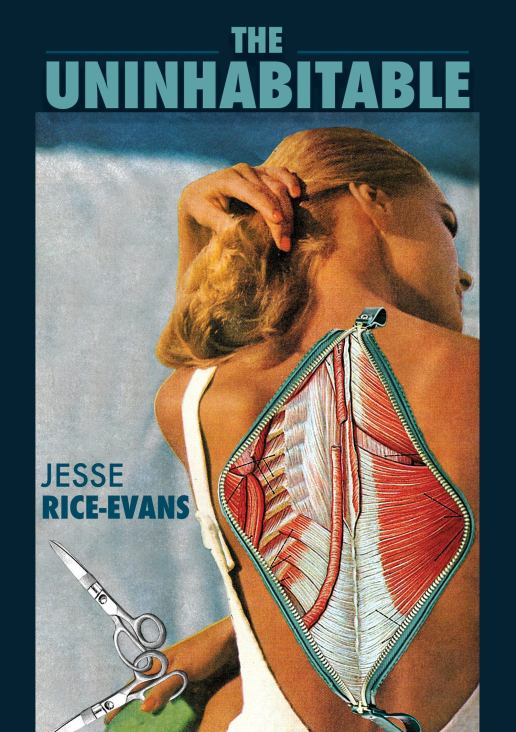
The Uninhabitable, Jesse Rice-Evans’ debut full-length poetry collection, left me breathless. It was an absolute honor to have had the opportunity to read this recent release. The physical meets the psychological; the self-awareness and the autonomy developed through storytelling were powerful. Her words held so much urgency—tangible, malleable imagery that was both rich in its unique uses of language, as well as in its sensory details. I was fortunate enough to chat with Jesse Rice-Evans.
FRONT+COVER+_2_.jpg
Sibling Rivalry Press

Savannah Slone: How does it feel to have completed your first full-length collection? What are your feelings on its release?

Jesse Rice-Evans: Oh my gosh, bizarre! The poems in this collection have been with me for so long in so many forms: dreams, delusions, stuff I’m good at keeping private.

SS: Can you discuss the shift and build-up of growth of self that takes place throughout?

JRE: Ordering poems in a larger project is not simple. This collection, in particular, needed help in sense-making, which hasn’t been my strong suit as I remain sick over time. Recently, I was organizing pieces in my new manuscript and felt like I had a strong grasp on what should go where, but I don’t remember this feeling with The Uninhabitable. What I do remember was growing too exhausted to fret about placement, and allowing many of the pieces to settle in wherever they felt comfortable, which ended up mirroring my own embodied experiences while writing the collection. Luckily, I had written a piece called “The Final One,” after the Jeanette Winterson quote, and that seemed like an appropriate choice to close the collection with.

SS: When did you start writing poetry? What about this medium drew you in?

JRE: I feel a little sheepish being one of those people, but I was a writer since I was super little. I didn’t feel that connected to my peers and was really into books about tomboys disguising themselves as boys to do things that girls weren’t allowed to. Relatable! I got more into poetry in high school when I attended North Carolina Governor’s School for a summer to study poetry, and then was rejected by every poetry program I applied to for college. After a few years of working nonstop and being too deep in survival mode to do much art-making, I left college for a few months, while dealing with mental illness crises, and transferred colleges after my junior year to UNCA (a small public liberal arts school in Asheville, NC). There was a rich community of writers there, and I joined up with the community writing workshops and met writers who weren’t writing the tired narrative stuff my professors seemed to love at my previous college, and I buckled down and wrote loads for the next several years. Then, more mental illness. Then, physical illness. These have forced me to slow down and develop patience—a skill that has never come naturally—and my writing practice has weirdly become a central way to work through trauma and pain, trying to make sense of the unexpected bloom of symptoms that forced me to radically reimagine my life while trying to unlearn the white supremacy I—and all white folks—grew up enjoying. Poems get to be slippery in ways that prose steers away from; there’s not always a clear narrative element in poetry, or at least in the work I am drawn to, and I am much more interested in affective and somatic connections with language than writing something with plot.

SS: How has your work evolved, since you began writing and publishing?

JRE: As my bodymind has demonstrated its ever-evolving needs w/r/t rest, I’ve gone through an intense process of grief. So much of my identity has been wrapped up in what I do, that is, through work in primarily intense physical contexts: food service especially. I started working on my 16th birthday and never took a break aside from a few months studying abroad in undergrad. I usually held down 2-3 service jobs at any time partly out of necessity and partly as a strategy to distract from a lot of trauma for which I couldn’t access any kind of treatment or care. The scariest part about developing the chronic pain and fatigue I now live with every day was that I require loads of down time, often spent alone. In the past, this was untenable: if I let myself feel any of the psychic pain I was holding onto, I feared an uncontainable flood. It wasn’t until I had no option but to rest that I accepted that I needed to face it, with the indispensable support of my therapist, partners, and friends. Then, the flood. Only, it bloomed unexpectedly into language, all of which I scrambled to capture in Google Docs on my phone. That’s really where this collection came from, and where the voice that now dominates my work emerged.

SS: How has earning degrees and teaching writing changed how you write?

JRE: It’s a bit of a different animal spending so much time teaching “academic” or “professional” writing and secretly writing poetry on my phone. I haven’t always connected these two elements of my life as my practices for each of them is super distinct and they each require such different ingredients for them to go the way I want. As I’ve moved up in the bizarre world of higher ed, I’ve definitely grown more and more fastidious about developing my voice in all types of writing. Theory is notoriously inaccessible and at this point in my career, this intentional opacity pisses me off. Gatekeeping is everywhere you turn in academia, and I’m up to here with the jockeying for privilege. In the classroom, I’m all about figuring out ways to understand an audience’s expectations and play to them with the intention of slipping anti-authoritarian practices under the radar. Unfortunately, I see this same sort of popularity contest in much of poetry culture. I did two off-sites at AWP because I don’t know the right people (but my editors do) and I definitely don’t have an agent. I have three part-time jobs and chronic illnesses and two partners. I’m way more invested in my students and myself than playing the exact games I caution my students against.

SS: Which poem, from this collection, would you consider to most wholly encapsulate the overarching ideas you explored?

JRE: This was hard, so I asked my friend Frankie Baker, an awesome poet also from North Carolina, to help me out. They said “Hypomania,” which is also one of the shortest pieces in the book, which opens with “Rebirth is just an awful edge.” I agree in the sense that it’s about how self-image shifts with illness, with memory loss, with growing up, and these themes are definite throughout The Uninhabitable and the new work that I’m writing. Right on, Frankie.

SS: Who or what influenced and inspired you, as you crafted the pieces within? Authors, activists, community members, media, specific books/works?

JRE: So many. I’ve always written with pop music as a backdrop—the femmer, the better—so Kesha, Shura, Crater, Rihanna, Carly Rae Jepsen, Janelle Monáe, Ariana Grande, Lorde, Solange, all deserve shout-outs. I was really into Jay Deshpande’s Love the Stranger right as this collection was really finding its feet, and I’m so grateful to the whole relationship I ended up having with his collection. This also marked the close of my obsessively-read-everything-Kate-Zambreno-has-even-breathed-on phase, so her singeing honest look at the abject was a huge influence to my work. Part of dealing with my ill health also meant finding connections online: Annie Segarra, Vilissa Thompson, Imani Barbarin, Jennifer Brea, Leah Lakshmi Piepzna-Samarasinha, Talila Lewis, other chronically ill academics, and writers I mention here are just a handful of a rich scene of awesome sick and disabled activists who challenge ableism and its intersecting oppressions through art, writing, and advocacy. I’m hugely in their debt for my own better disability justice politics, including some of the conflicting experiences I talk through in the collection.

SS: Who are some queer and/or disabled poets who inspire you?

JRE: Eli Clare, Cyrée Jarelle Johnson, Leah Lakshmi Piepzna-Samarasinha, my amazing partner Zefyr Lisowski, the late Tory Dent, Kai Ulanday Barrett, everything put together by Deaf Poets Society and Monstering. I am careful about this term inspired in relation to other disabled writers, though, as so often sick and disabled people are used as metaphors for abled folks to fetishize. These poets motivate me and challenge me.

SS: How do your disabilities play a role in your writing process?

JRE: Well, I’m pretty much always lying down and my cognitive issues are less severe than even a year ago, but it’s not like I ever have the ability to be like “time to compose some poems!” Usually, I’ll be reading something or watching Grey’s Anatomy/playing Candy Crush on my phone and hear a phrase or term that interests me. This actually happens a lot watching Star Trek (Voyager and DS9), as well as nature docs, so I have a running list of notes in a Google Doc called simply “2019” that holds all of my in-progress gibberish before I try to shape it into anything legible. My memory issues also mean that I return to these fragments unsure of what I intended when I first jotted them down, which is kind of freeing; I can take fragments that I didn’t associate logically as I was writing them and instead play with juxtaposing weird observations and sensations in a non-rational way, which is so much of how my brain works now. I love this blank slate feeling, as I don’t beat myself up for missing a narrative opportunity. Instead, it’s a kind of poetics that I’m really attracted to and grateful for.

SS: How could the literary community do better, when it comes to accessibility and inclusivity?

JRE: We love to plug up “inclusive” pubs with professional writers and writers who have agents, writers who get to be full-time artists. On my (long) list of writers I love, none of them can afford to be an artist for a living which, gross capitalism sucks, etc. but loads of writers actually will be fine if they never make any money from writing. And they’re not trans women of color, sick and disabled folks, and poor writers. The cultural workers doing the political groundwork and advocating and taking up space with their shifting privileges are invariably from working-class backgrounds because when you’re poor, you have to give a shit about your community or you’ll all die. Rich writers need to honestly give their money away because they probably stole loads of brilliant work for marginalized writers and will never get called out on it because popularity politics always benefit thin, white, abled, cishet people. Always. Also, hold your fucking readings at accessible venues. It’s such a huge slap in the face that so many literary connections happen at readings that huge numbers of us can’t even fucking get into. If you wonder why there are no disabled people at your event, it’s because it’s inaccessible. Fix it and invite us!

SS: You belong to two marginalized communities, yet still, of course, hold privilege as a white person, which you acknowledge in this collection. What role does whiteness play in your craft?

JRE: My whiteness obviously grants me so much access to spaces and authority esp in academia! I’m automatically more listened to and believed in medical settings—tho anti-fatness is a popular ideology for medical professionals as well! I mean, ultimately I’m pretty much always totally safe: not being perceived as threatening means I have the privilege to go about my goddamn business without getting harassed, threatened, the cops called on me. I’m on the fine line of too-fat-for-street-harassment and too-not-fat-for-public-fat-shaming, which extra means that I get left alone. Now I’m working on a few pieces that tackle my whiteness and whiteness more broadly further in-depth, as I still don’t see white writers talking about our own race, racism, and investment in white supremacy, which every single white person in the universe practices and benefits from. This is striking to me, especially as “woke” whiteness is socially popular and rewarded (usually by other white people). Where is the “woke” white poetry that isn’t ableist, racist, fatmisic, transmisogynistic, classist? It’s almost like if we gatekeep people of color—and Black folks especially—out of the activism, academia, whatever, we (white folks) scramble to find someone else vulnerable to target to remind us of our position: at the top of the hierarchy that we do unspeakable things to enforce.

SS: Do you feel a social responsibility as an artist? What motivates your relationship to your own voice, as well as to your specific audience?

JRE: YES. But also as a now-middle-class person working bougie academic jobs, I have a responsibility to use my cultural power to make a fuss about injustice. I am super exhausted, but I have to work all the time to push back on this shit.

SS: What would you say to emerging writers and artists who are creating in this ableist, heteronormative society we exist within?

JRE: It’s not worth it to get sucked into the respectability politics of lit/art world. Don’t trust any institutions. Read a lot about how capitalism and colonialism ruin art and bring this up all the time; you’ll find out who you can be real with super fast.

SS: What are you reading lately?

JRE: Funny you should ask. I am finalizing reading for my second exam towards my doctorate in English composition and rhetoric. So I’m reading lots of cool scholars who think through language, the body, interlocking oppressions, and teaching: Jasbir Puar, Foucault, Anne Boyer, Carmen Kynard, Harriet A. Washington, Liz Bowen, Tory Dent, Brittney Cooper, Margaret Price. As I mentioned, I’m currently paid an annual fellowship to read and think and write, which is definitely the most low-stakes job I’ve ever had, so it’s important to me to use this incredibly privileged time to get smarter about how power works so I can tackle this stuff in the world!

You can buy Jesse Rice-Evans’ The Uninhabitable here.

Jesse Rice-Evans (she/her/hers) is a queer femme rhetorician and doctoral student at the CUNY Graduate Center researching intersections of language, disability, and digital culture. She is the author of several chapbooks; this is her first full-length collection. Find her at http://www.jessericeevans.com.

Jody Chan

the podcast defines nostalgia
+++++++++++— for Amil

as a defense mechanism, an escape
from present dissatisfactions to the past.
you explain this to me over herbal tea

& chickpea stir-fry in your kitchen, the roof
strung with saggy balloons from an ex-roommate’s
birthday party — nostalgia’s utility & how birds

would foliage the air with their good-morning
songs as your grandfather walked you & your brother
to school, back home in Guyana. I mean home

like a metaphor, I mean maybe this overdressed kitchen
on Cecil, where we amble through nature documentaries
& Hong Kong classics, a film club of two. missing

the point, I tell you I want memories for my future
nostalgia to latch onto. I have a habit of falling asleep
on your couch while you toss exclamation marks

into the air over tree frogs & cinematography.
forgive me. time with you tends towards ellipsis,

the exact right amount of distance between words.
I haven’t been sleeping well, lately. lately my brain

is a toddler throwing tomato sauce tantrums
into every stillness, except here in your kitchen, your
presence quieting the racket, painting the walls clean.

sometimes, restless, we trudge the hill to Casa Loma.
with Spadina splayed beneath us like a star-hemmed
scarf, the night elongates into a single runny sentence.

every morning, you say, you wake up missing everyone.
missing the point, I muse that memories are just films
told from a first-person point of view. Amil, in this

movie, you are the breath before the soundtrack’s
final chorus, when the melody grazes a higher octave.
or, you are the whisper of the drummer’s feet, tapping

on the floor to keep the beat. this is to say, I think
the song would fall apart without you. Amil, don’t miss

me. this night will end. tomorrow’s night will end.
but you, more than anyone, are fluent in the silent
spaces between one world & the next.

supporting evidence, seventeenth floor

the bedspring whispers, four creaky jambs; a haunted
house after the actors have left.

my palms pray into the pillow, wrists bent double.

the slats, long cracked, cave to our weight.

past the window’s shatterproof glass, a city’s anonymous dark; penetrated
by light, proof that life goes on for other people.

an empty socket sparks. dreams
split; ghostless, until morning.

Jody Chan is a writer and organizer based in Toronto. They are the poetry editor for Hematopoeisis and the author of haunt (Damaged Goods Press, 2018) and sick, winner of the 2018 St. Lawrence Book Award. Their work has been published in Third Coast, BOAAT, Yes Poetry, Nat. Brut, The Shade Journal, and elsewhere. They have received fellowships from VONA and Tin House. They can be found online at https://www.jodychan.com/ and offline in bookstores or dog parks.

Timothy Rico-Storey

Thoughts While Taking a Piss in the Men’s Room at the Atlantic House in Provincetown, MA

The first thing: Tennessee Williams walks naked
On a P-town beach downstairs in an oversized
Photo on the wall. Tastefully concealing his
Member by a crossed leg, the playwright strides
Under the sun. Upstairs in the Macho Bar’s
Dimly lit toilet, walls papered
In yellowed, faded images precisely cut
From the pages of Honcho and Inches and Drummer,
The next thing: these men and barely
Men, display cocks and asses,
Proud but in shadow, on the walls
Of the head where just a tiny
Ray of sunlight might make its way
Through a high, narrow window.

True, we queers come out more regularly in places
Like P-town, tourists among tourists,
Emboldened away from where there’s
No place like. Example: the two lanky
Cowboy-hat-and-boot-wearing men,
Who were walking down the street
Just this afternoon, arm in arm,
In nothing else but Ginch Gonch briefs
And sunglasses. Emboldened because,
Yes, no one cares because, yes, the tourism board Encourages the display for the breeders who,
Yes, now bring their pre-teen children to
Gawk. So the queers come out as we are
Always coming out. Like the cock
Of the walk, proud, decadent,
Snickering at the gawking,
Flesh and sinew on
Capital display,
Queer meat brings
Cash.

So I wonder, really, is this the P-town
That Williams and his ilk would have
Known? Walking naked on the beach—
Was this not the more greatly subversive
Act—photographed and displayed
For generations with no cover
Fee?

Still, in some regard, this upstairs getaway,
With its red lights and black walls
And nonstop hardcore mansex projected
On the screen opposite the bar,
This sanctum superiorem
Where fagboys and butchdaddies
And leathermen congregate around
Overpriced beer and strong cocktails
Sharing cock tales and over in the
Unlit alcove caressing cocks and tails,
This murky radar blip stands
Like an inverted lighthouse,
A pinpointed darkness that says:

+++++We are here, US of A, and
+++++You will forever wonder at
+++++The mechanics, ignoring
+++++The grammar of bodies
+++++That lust in a different
+++++Syncopation that you dare
+++++Not beat out.

Zipping up, I do not know
If protocol here demands
That the pisser be flushed
Or if the leathermen relish
The acrid build up of a night’s
Shared urine. I choose to
Flush and rejoin my husband
And a stranger
In the alcove in the dark
Above Williams above
His sun.

Timothy Rico-Storey is a part-time lecturer of freshman composition at the University of Louisville, in addition to being a writer and introverted menace. He lives in Louisville, Kentucky, with his husband. You can find him on Twitter at @anilomit