Sarah A. O’Brien

Sometime Before Seattle

To be honest
(I’m feeling extravagant),
I don’t recall pouring water
on your head last July,
but damn. Wish I remembered.

Bartender has a voice like sex.
I’m going to hit on her.
You’d tease me about this.
I need to hear your voice again,
please?

Sarah A. O’Brien is a bisexual poet and painter from Woburn, MA. She is the founder and EIC of Boston Accent Lit. Sarah earned her MFA in Writing at the University of Nebraska-Omaha. Find more of her work at http://www.sarahobrien.org.

sally burnette

why american policy is leaving millions hungry (Washington Post)

why american policy is leaving millions hungry
why american policy     leaving millions hungry
why america   policy     leaving millions hungry
why america                   leaving millions hungry
why america                                 millions hungry
why america                                                 hungry
why america
why

christian extremists ’let their baby starve to death’ (The Week)

christian extremists ‘let their baby starve to death’
christian extremists let their baby starve to death
christian extremists let their baby             to death
christian extremists       their baby             to death
christian extremists                 baby             to death
christian                                      baby             to death
christian                                                             to death
christian                                                                  death
death
eat

sally burnette is the author of laughing plastic (Broken Sleep Books) and Special Ultimate: Baby’s Story: a Documentary (Ghost City Press). They read flash fiction for Split Lip Magazine. Their work has been published in Glass: A Journal of Poetry, Indianapolis Review, pidgeonholes, and elsewhere. They’re from North Carolina but currently live in Boston.

Joanna C. Valente

Elvis Impersonator

When Elvis-Not-Elvis orders a drink, he always orders a gin & tonic, unless it’s wine; in that case, it’s always a dry red wine. When Baby Girl and Elvis-Not-Elvis went into a restaurant around the corner from his job, he ordered a drink as soon as the waiter gave them menus. Baby Girl wasn’t sure what to think, although she felt like she should think it was weird. But she didn’t—or didn’t want to.

“So, you do actually believe in the abyss?” Elvis-Not-Elvis asked abruptly.

“Yes, I do. Aren’t we in it now?” Baby Girl smiled.

“Maybe. Yes. No. I don’t think so. I think life is generally super awesome, honestly. Although I do think about killing myself every day,” he said, then added, “But you know what I mean. You feel it, I’m sure.”

“I do. I know.”

“So, what’s your deal? What do you do? Where are you from? I bet you’ve listened to The Cure since you were like 12 or something, right?” Elvis-Not-Elvis asked, sipping on his gin & tonic without raising the glass to his face, instead lowering his head to the straw.

“Um, yeah, you totally have me pegged. I wish I could say I was joking. I’m from Brooklyn, grew up in Bay Ridge. I’m a gallery assistant, my boss is OK, mostly chill, though drinks a little too much, honestly. That’s kind of it. I feel like a cliché.”

“So, do you make your own art? Or are you just busy selling other people’s?” His question caught her off-guard—she could feel her face burn, a sun melted into her skin—and she had to blink back tears, pretending to look out to the street, as if she was actually watching cars and people pass by. As if she could just pass by him and his remark.

He sipped his drink and fingered the straw, furrowing his brows as if he realized he made a mistake. He looked up at her and saw her eyes dart away, saw her become small in her seat.

“I do. I guess you could say I’m a photographer and painter. I mean, I went to school for it,” Baby Girl said breathlessly, “I’ve had my work shown in some small gallery shows. Not for a while though.” She looked down as she said this, not meeting his eyes, which she had noticed were neither brown nor green, but more like a golden green — the kind of green like a rusted statue.

“That counts. You don’t need validation to be an artist. It doesn’t matter. It just matters what you do… You know I wasn’t being critical, I was just asking. I’d be curious to see your stuff.”

“No, it’s fine. More people should be as blunt, honestly. It wakes you up. At least, it did me. What do you do, besides work at a restaurant?” Baby Girl asked, feeling less like she was giving a presentation in front of her high school English class. He suddenly seemed boyish, unsure of himself—he brushed his hair back, the curls still bouncing back, covering his eyes.

“I’m in a band, you know, like everyone else.”

“Oh, what kind of band? What do you play?”

“I’m playing a show on Friday. Come to it and found out for yourself,” he said, coyly, indifferently taking out a pack of American Spirits. Their food appeared quickly out of nowhere, as if their waiter was a ghost—and Baby Girl didn’t remember ordering anything, only studying Elvis-Not-Elvis’ deep lines in his forehead, the tattoos that made up a sleeve on his left arm, the purple paisley shirt with his sleeves rolled up, his slightly-too-worn Doc Martens.

They ate in silence for a few minutes. Baby Girl would occasionally look up to see him busily dip his fries into the ketchup-mustard mixture he created, and she would take tiny bites of her mac and cheese, not sure she was even hungry, already planning to take most of it home later to eat ravenously on her bed alone.

Her phone vibrated—BJ texting her asking her where she was, if she was still coming, if she wanted to get a drink after. She didn’t know what to say, so she didn’t say anything at all.

“I feel bad, my friend whose art show I’m skipping just texted me,” Baby Girl said, surprised she was admitting to being a flake.

“So, fuck ‘em. How many of their shows have you been to?” Elvis-Not-Elvis asked, looking straight into her eyes, as if he knew she never flaked, as if he knew she needed to be more selfish sometimes. As if he knew.

“Too many, I guess,” she laughed, “but I still feel kind of bad. I hate being that friend.”

“It’s OK to be that friend sometimes, you know. Especially when you get dinner with strangers.” He was smiling. She knew he was right. She didn’t even need to say anything after that. For a while they sat in silence, until Elvis-Not-Elvis went over to the digital jukebox and put on The Cure’s “Just Like Heaven” and they listened to the song together, occasionally smiling and nodding their head, until it stopped and he leaned off and asked if she wanted to go.

And so they did. They left together as if they had known each other all their lives, as if they had all of their lives left.

Joanna C. Valente is a human who lives in Brooklyn, New York. They are the author of Sirs & Madams, The Gods Are Dead, Marys of the Sea, Sexting Ghosts, Xenos, No(body) (forthcoming, Madhouse Press, 2019), and is the editor of A Shadow Map: Writing by Survivors of Sexual Assault. They received their MFA in writing at Sarah Lawrence College. Joanna is the founder of Yes Poetry and the senior managing editor for Luna Luna Magazine. Some of their writing has appeared in The Rumpus, Them, Brooklyn Magazine, BUST, and elsewhere. Joanna also leads workshops at Brooklyn Poets. joannavalente.com / Twitter: @joannasaid / IG: joannacvalente / FB: joannacvalente

Alex Clark

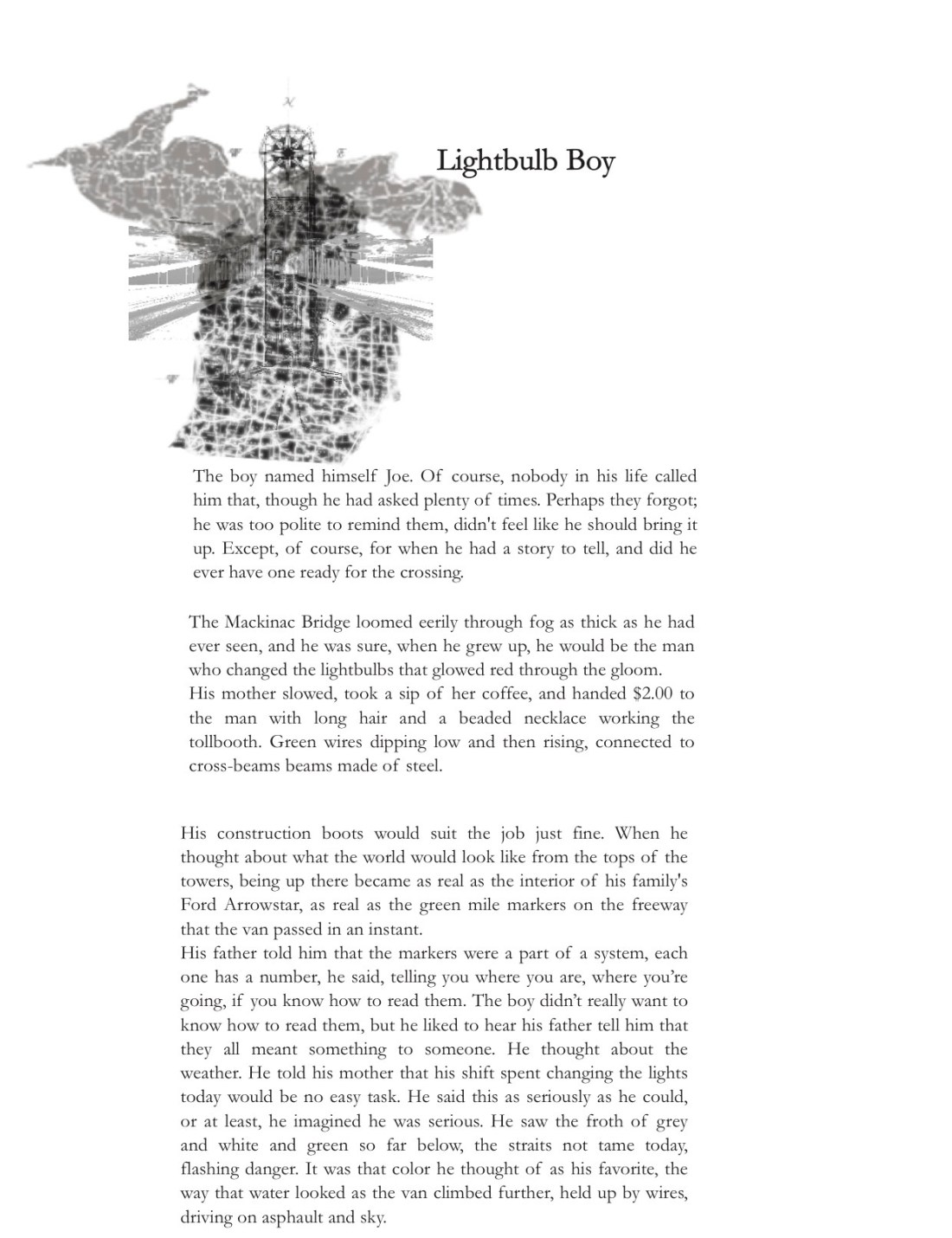
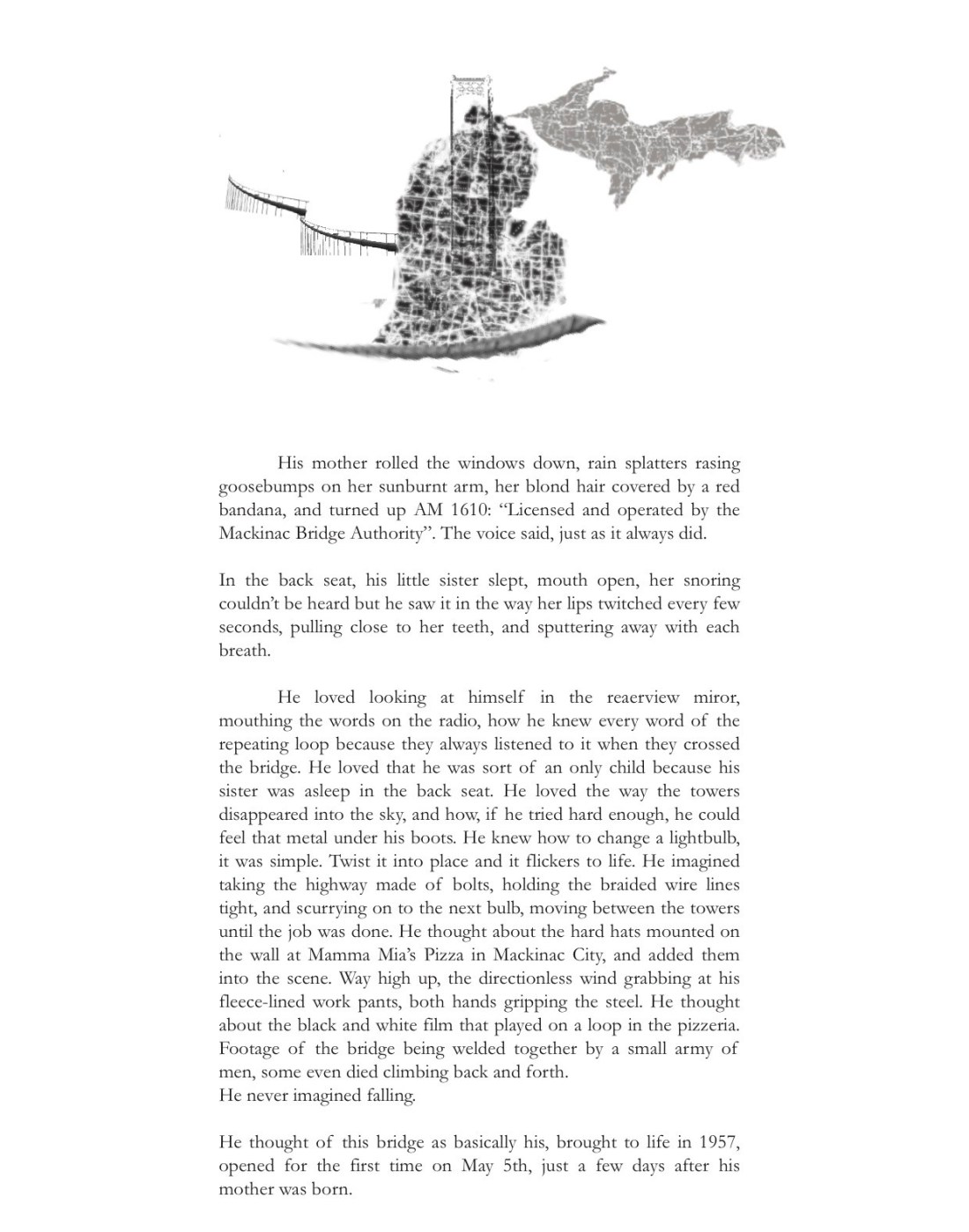
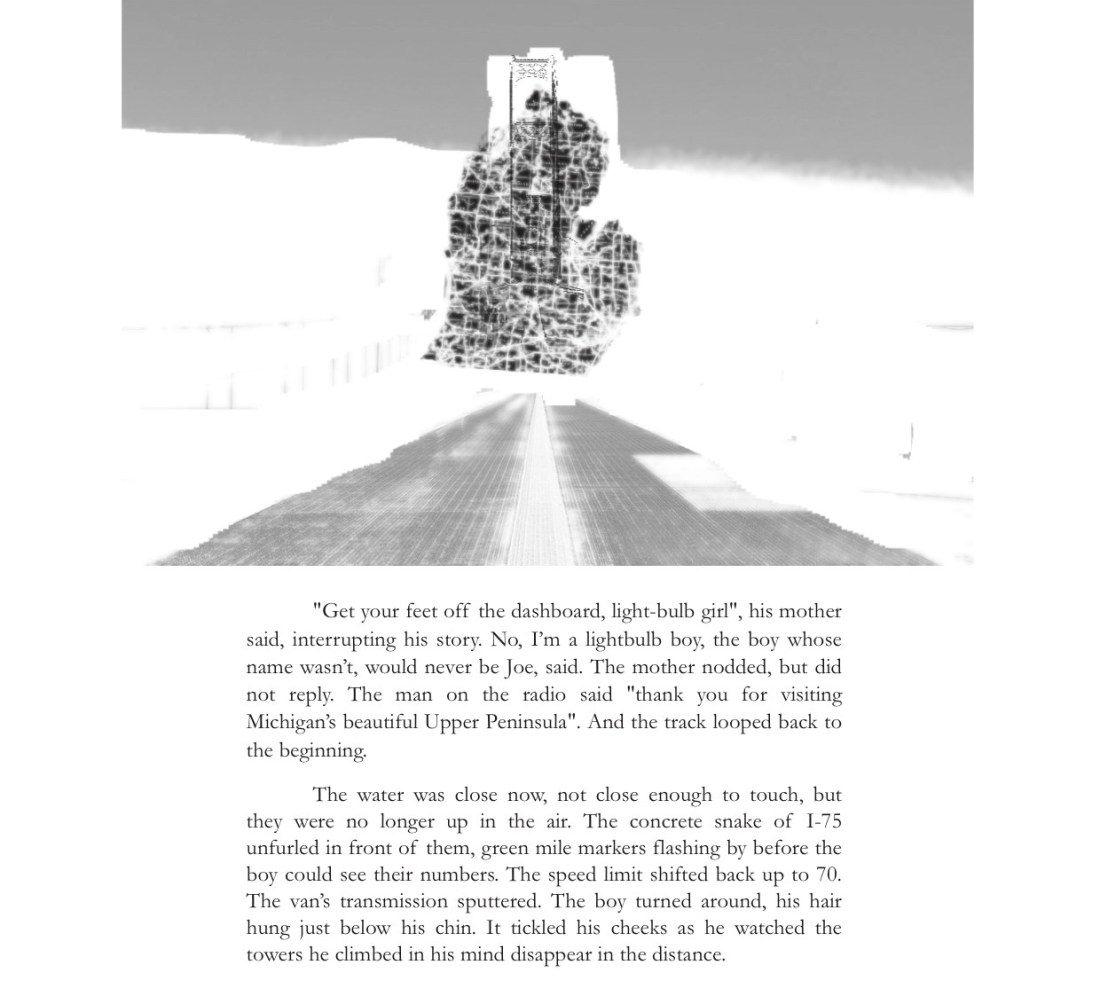
lightbulbboypdf.jpglightbulbboypdf-pg-2.jpgLightbulbboypdf pg 3lightbulbboypdf-pg-4.jpg

Alex Clark is a trans-masculine essayist, poet, and artist from Marquette Michigan. He is an assistant editor at Passages North. His hybrid essay, “A Fractured Atlas”, was selected as runner-up in Booth’s 2018 non-fiction contest, received an honorable mention in Storm Cellar’s 2017 Flash Majeure Contest, and was chosen for Crab Fat Magazine’s Best of Year Four Anthology. His work also appears in Booth Online, Storm Cellar, Crab Fat Magazine, Foliate Oak, and Barking Sycamores.

Lea Anderson

the carousel

it is peak summer
and I am eating
600 calories
per day

melting
in a sun-soaked
rose-tinted
spun-sugar
euphoria

feeling like a god
high on my body
eating itself

i think when you burn
you burn ecstatically

there in a room full of unblinking people
flames cartwheeled from my mouth
cackled like laughter

what do you think happens
to a body that bends
its own truth backwards?

reeling in the negative space
death seemed beautiful
in the way absence
seems beautiful

so quiet
and sterile
and clean

monologue of a jezebel (in five parts)

i.

white boy is unaccustomed
to staring or else
gets off on it

ii.

on the phone at 3am
when the air is heaviest
white boy says he’d make me
his girlfriend says

but
he’s uncertain
if he could ever
bring me home says

his father would approve
as his father approves
of all his sexcapades

but Spring Hill
is a small town
rural     you know

iii.

white boy loves my body
hates that he loves my body
and I understand
because I hate my body too

have resigned myself
to my rotting alter

its disproportion
the width of my thighs
spilling across a seat

i need white boy to tell me
i’m pretty to tell me i’m beautiful
words white boys only use
for white girls

iv.

white boy tongues
the deepest parts of me
gnaws through my legs
thick and unladylike
picks tiny black hairs
from between his teeth
he runs his hands
down the length of me
smooth as a palm run
through sand – deliberate
as an angel appearing

v.

white boy is problematic
to say the least
but when he kneels
to fuck me I am certain
he is seeing god

Lea Anderson holds an MFA in poetry from The New School. Her poems and other writing have appeared or are forthcoming in SWWIM, Jai-Alai Magazine, and Luna Luna. Follow her on Twitter @leaeanderson

Danez Smith

poems-for-dujie-1.jpgpoems for Dujie 2

Danez Smith is the author of “Don’t Call Us Dead” winner of the Forward Prize for Best Collection and a finalist for the National Book Award. They are the co-host of VS with Franny Choi, a podcast sponsored by the Poetry Foundation and Postloudness. Danez’s third collection, “Homie”, will be published by Graywolf in January 2020.  

Terrence Abrahams

On the first day of spring

we went down to the field and we fucked. It was that simple. There was the scent of grass and also maybe the clouds, which I ruefully imagined smelled not of new rain but something older, tinged with copper, the lingering aftertaste of river water that’s okay but not great to drink, which we of course had drunk despite the warnings. When you swallowed, I looked away. I remained thirsty, hating the body I wore for sweating, loving the clothes I wore for loosening, and wishing we had been anywhere but there. What is it about open spaces that outs me? I can’t place it. I know I am bipedal and taller than most grasses. I am not afraid of the void of a hawk above. I am consenting to the simplicity of fucking in a field. Our bodies made new shapes out of the grass, flattening it, the insects tangled within it introduced to new concepts like weight and shade and salt. Concepts I, too, was estranged from until you. But they are here to help ground me. Now here’s a fact, not a concept: a field can be cut in half with a river. A mountain, too, can be worn down by the water. What these geographies do to change their appearance is accept the slow work of everything on the outside. A mountain has a centre. A river has an origin. I wanted to be as fluid and whole as both.


Terrence Abrahams lives and writes quietly in Toronto. His work has appeared in the Puritan, Peach Mag, Hobart Pulp, Cartridge Lit, and many gendered mothers, among others. He has a MA degree and two poetry chapbooks forthcoming in 2019.

K. Noel Moore

Naming Ritual

+++++++You have a plan.
+++++++You had a plan. You aren’t so sure about it anymore.
+++++++The plan you had started with lying to your family. Sitting in Babcia’s living room, pretending you don’t notice how handsome your cousin’s fiancé is. (He’s a Marine; she’ll tell anyone who’ll listen to this fact, also anyone who won’t. You don’t believe in the military-industrial complex, yourself, but the look of his muscles under that sweater is enough to make you want to set aside your convictions for a night.) Telling Dziadek, when he chides you for the makeup on your collar, that you’re in theatre; you are, but it isn’t the reason for that smudge. (You can’t let him know you’ve been sneaking into your sister’s makeup bag, posting photos of yourself online with ridiculous gold eyes and bright red lips.) Lie after lie after lie.
+++++++The second step: put an end to the lying, finally. Tap your glass with a spoon as everyone gathers for dessert, just like in the movies, and when all eyes turn to you, say it. Say it at last.
+++++++That’s how it was supposed to go. The plan has changed a bit now that you’ve panicked. With the smell of latkes sticking in your nose and inane bilingual chatter ringing in your ears, you locked yourself in the smallest bathroom in the house and lost your shit: crying, pulling your hair, you wanted to be sick but you wouldn’t let that happen. (Someone would come looking for you if you were sick.) You lay in the fetal position on the tile floor, trying to remember how to breathe.
+++++++The sounds of December 25th festivity (Christmas proper is a somber occasion, so Protestant Christmas is the time to celebrate) were like so many buzzing wasps, so you climbed the narrow stairs to the attic to escape. You like attics; you like the possibility they hold, that feeling of never knowing what you’ll find.
+++++++The first thing you found was the old cushion-less beige couch you knocked your shin on. Then a Seward trunk, something right out of a black-and-white film. On wire shelves, you found hardcovers missing their dust jackets and mid-90s board games in fraying boxes. In cardboard moving boxes: your mother’s prom dress, a book of your own baby pictures, cracked Christmas ornaments, little plastic baubles from the chocolate eggs Babcia brings home from Europe.
+++++++Inside the old trunk, simpler things: letters, photos, trinkets. The letters were in Polish; you could read only a few words. (Zima means winter. Kochanie means my love. Dlaczego is the beginning of a question, why, but you can’t read the rest.) You feared they would crumble at your touch, the photos too. One image shows a young mother on a stoop, holding a baby. Another shows a dirty barefoot child, with big eyes just like yours. A name on both is familiar: Ania, your Babcia’s name. Lidka i Ania, 1942. Ania, 1955.
+++++++
Lidka, you remembered, was your great-grandmother’s name. You know your great-grandfather’s well because it is yours now: Aleksander.
+++++++The trinkets fascinated you the most: a handheld mirror, a chess piece (the white bishop), a toy dog carved out of wood. The talismans of a refugee family. The last pieces of home for a Socialist and a half-Jew and a daughter born into terror.
+++++++The last object you found was a rosary, with the Orthodox cross hanging at its end. Its beads are dark redwood, and the cross bears blue and gold detail work. It’s a beauty. You’re wearing it now. It was when you hung it around your neck that you had that madcap thought.
+++++++You have a plan.
+++++++The new plan starts with a Sharpie and the inside of an empty Monopoly box. A B C D, YES, NO, GOODBYE. The cap from a bottle of Diet Coke will serve as your planchette. Candles smuggled from downstairs create atmosphere. You are going to contact your great-grandfather — your pradziadek.
+++++++You will tell him that you first wanted to kiss a boy when you were twelve, watching Notorious with your mother — to this day, you wish you could be Ingrid Bergman, kissing Cary Grant in Rio. Tell him you’ve been in love with one boy in particular, named Devin, since you had ninth-grade biology class together. Tell him you go by Sasha now, not Aleksander or Aleks or Aleksey (your living family knows that part already, though they refuse to honor it). Before you call your family to attention to declare I’m gay, you will whisper it in a makeshift séance.
+++++++You will tell him other things, things you would never tell the living. Tell him that you’re worried for Devin; you see him drifting away a little more each day. (He’s started to cut his arms.) Tell him you hate your full name, Aleksander Bogdan Marshall, mostly your middle name, Bogdan. It means given by God, and you don’t want to be given to anyone. You want to belong to yourself, and yourself alone. You will tell him (fingering the beads around your neck as you do) that you aren’t Orthodox anymore. You aren’t even sure you believe in God. The Church you once loved has become a stained-glass cage.
+++++++You have a plan.
+++++++You’ve heard that names have power, especially when reaching the other side. You repeat it three times, the name that is his and yours. Aleksander Marszałek. Aleksander Marszałek. Aleksander Marszałek. One hand on the bottle cap.
+++++++“Hello? Is anyone here?”

K. Noel Moore is a writer of both speculative and realistic short fiction; recently, she has been published in Luna Station QuarterlyVulture Bones, and X-R-A-Y. She believes in the power of names. You can find her blogging at theoutlawwrites.tumblr.com, or tweeting @mysterioustales.

Elliott Bradley

A Mother’s Prayer

The same people who don’t know your fullest being are the first to claim the worst fruits as their favorite. Kiwi, tomatoes, watermelon. I cannot say much as you look into my eyes. It is the winter after our last conversation. My God has left me out to hang, and dry.

The expectancy drops my words before your feet; waiting for you to pick them up and put them in your ears to listen to a cassette tape of things I could not burn onto a CD (nor onto paper). There’s so much I cram into your voicemail-box. I speak of the times we went around town embracing the homeless. I speak of the times we argued. I speak of the times you left.

“Do you know what you remind me of?” I ask you, on my fifth voicemail. “Cherries.”

There’s much more. Tupac collections, burned Bibles, the smell of savory things. Farmer’s markets. But cherries most of all.

“Did you enjoy it?” pause. “How fruits sprouted from your innocence: when you believed there were good men; when you kissed thinking you’ve left no bruise; when you walked down the street failing to realize every boy was thinking about cherries and how they blossomed from your womb like a tree in Africa. The pear of your figure, the coconuts upon your chest, the purging of your mother’s deliverance to become who you are.”

“Do you remember the talks your mother gave you? The ones about colonizers? Those ready to pick every one of your resources? Did you understand she wasn’t just talking about the white men?”

“You, you my Love, let women displace every one of their childish ways on different parts of your motherland, until the resources dried up, until the leaves from your tree stopped growing; until after they were already exported to places never meant for them; until they were processed into pieces so small they don’t recognize they were once part of your being. And it’s worse you didn’t know until it was long overdue,” I said in the seventh.

I’m ashamed to say I didn’t end there. On the eighth, I cried for you. Prior to the ninth, I sobbed as I thought of how they spit pieces of humanity out of their mouths like apple seeds. Have you forgotten how you used to turn into a Pink Lady as their little Jonathans had Galas? How their Granny Smiths don’t look them in the eye since they’ve been building Empires on broken women’s imports?

Are there still coffee rings on top of your mother’s gospel?

Is my silent worship going unnoticed as you fail to requite my love. Will you not call me back?

Their stares were the perfume on your skin, the tears in your eyes, the GMOs I was not yet immune to. You were right. I should’ve never told the public about your orchard. All they do is mass consume, destroy, and throw away perfectly good fruit.


Elliott Bradley (they\he) is a junior with big dreams of becoming a writer. Bradley has been published previously by Teen Ink Magazine & Rag Queen Periodical for his personal pieces on their black, queer experiences. They can be found on Twitter & Instagram @ayeelliottmyguy, but can also be found in the nearest library, SAT Prep Center, debate tournament, or where there’s music.