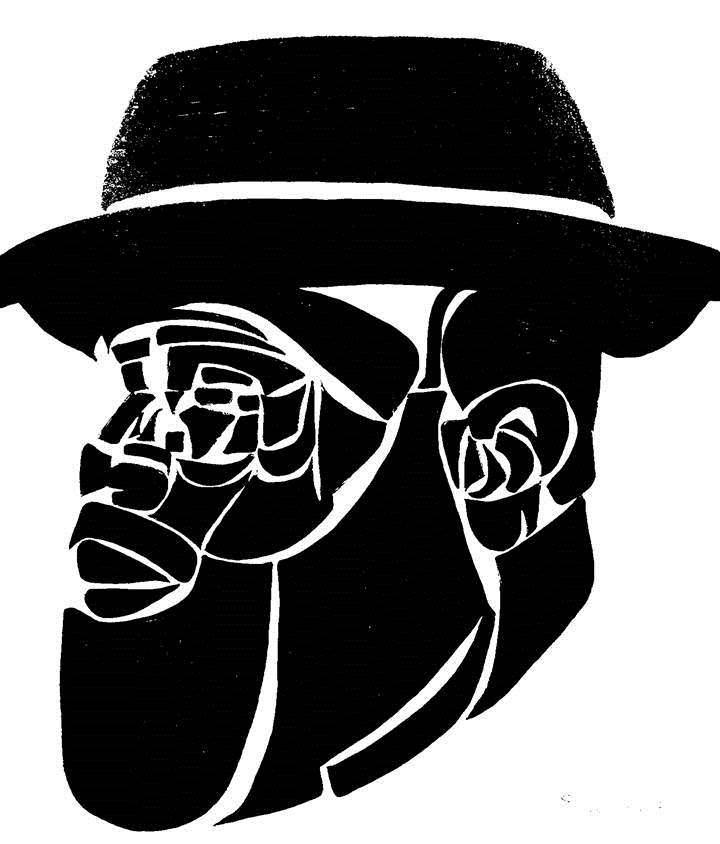
Ronny Ford

the-slowest-thing-e1553281609463.jpg


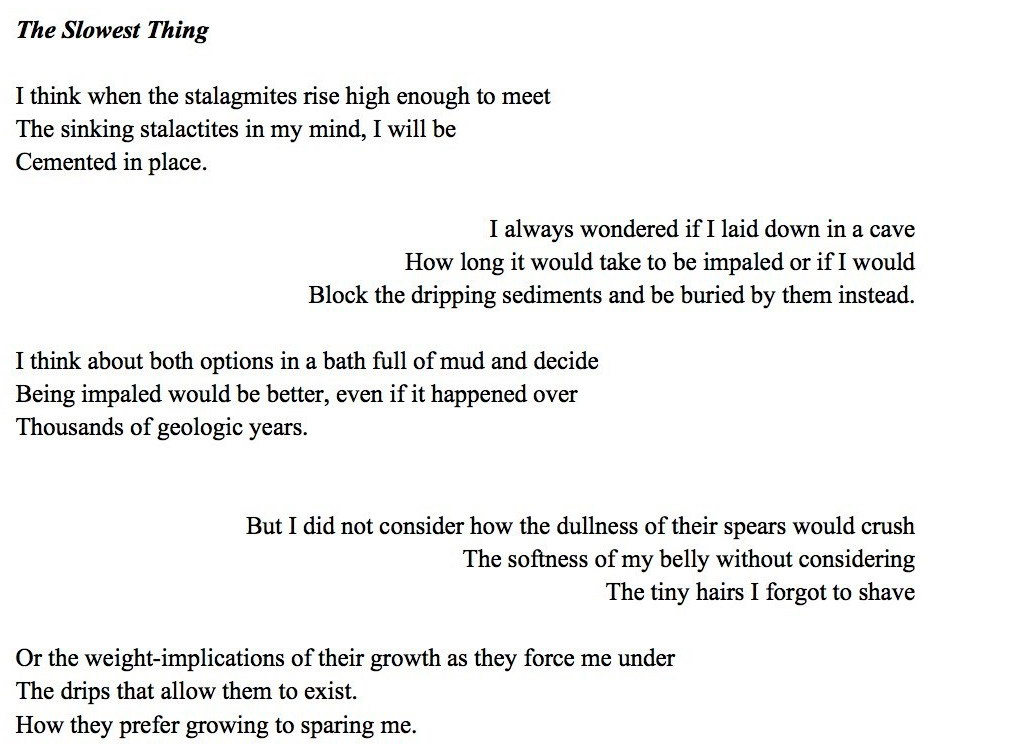
Ronny Ford is beginning the first year of his Ph.D. at Michigan State University, where he is studying Medieval Literature. Ronny obtained his Bachelor’s from the same university in the subject of creative writing. His poems have appeared or will soon appear in Sagebrush Review, Vagabond City, Cerurove Press, Junk Drawer of Trans Voices, and on Oceans and Time Blog.

Erin L. Cork

Real

I’m a dog to your bell you said with a grin. Maybe it was a different expression. But that’s how I remember it. We were new back then, still uncertain but answering the call.

++++++++++++++++++++++++++++++++++*
We lived in a world of temporary arrangements. We walked into the woods flinching with every shotgun blast. It was late fall, hunting season. What remained on the trees was torn away by wind and flurries. The ground a mix of mulch and crusty mud under a skiff of snow crunched beneath our feet.

Hunched against the cold in winter jackets, capped heads and gloved hands. It wasn’t the best day to wander off road with no orange vests to protect us from a tragic mistake. If we could have read the leaves we might have recognized that our timing would be off. Maybe.

The owl surprised us when it lifted off of a power line and flew into the pines. We understood that we had witnessed something sacred. The smell of winter approaching and your skin caused me to catch my breath. Turning back, I was sure that you were going to say something else. I pushed my hands into my pockets, tightened my shoulders and braced for it. You looped your arm through mine and pulled me towards you.

++++++++++++++++++++++++++++++++++*
It went like that. We misread each other. But we kept at it. Maybe it was stubbornness or dogged loyalty. Weariness. Resignation. Hope?
++++++++++++++++++++++++++++++++++*
We never imagined a wedding day. Not in our lifetime. Didn’t dare to. It’s staggering what we get used to. A lack of expectation and acceptance is routine.

When we decided to do it, it was no big deal. Really. It just made sense to let our wishes be known. It was merely an opportunity to clarify. A practicality. Protection if something happened.

We’d seen aftermath. Parents and siblings swoop in like a murder of crows. Leaving only the bones of a life spent together for the surviving partner.
++++++++++++++++++++++++++++++++++*
We traveled back to the state where it all began. It meant something. Love was legal there. The Supreme ruling would validate us later that year. Nervous and sweaty-palmed we stepped up to the window, applied for the license and chose our Justice carefully.

The surprise came in the emotion. A ceremony shared with a handful of loved ones. The laughter. The tears. The kiss. It was beautiful. We felt solid. Real.

++++++++++++++++++++++++++++++++++*
It’s not hard to recall the moment I first saw you. Ahead of me in the checkout line, the junk food I tossed on the belt and the sun, spotlighting you through the window.

Jumping in my truck, the cassette deck whirring into an old song. I drove up and down the streets trying to find you, the scent of spilled coffee and dirt road dust wafting through the vents. That day changed my life. You never remembered it. That’s not how it happened for you.
++++++++++++++++++++++++++++++++++*
On our wedding day, I fell again. I was yours. You were mine. After twenty odd years and averted disasters, I finally believed that we would last forever. We had earned it. Endured.
++++++++++++++++++++++++++++++++++*
It went like that. Until it didn’t. Irritation replaced compassion.

“I know. I know. Please don’t say it again.”
+++++++And
“I’m tired.”
+++++++Or
“Maybe you could vacuum once in a while, make the bed, scrub the toilet—take your muddy shoes off.”
++++++++++++++++++++++++++++++++++*
Plates that had stabilized rumbled. Shifted. Support we had taken for granted slipped. Shook. Pictures tilted on walls. Chairs slid across the floor. Bedrock gave way. Desperate to save ourselves, breathe on our own, we abandoned each other. We struggled for air, gasped, and choked, stopped compressions.

Death did us part. What did it mean? Was the collapse bigger than us? Did it signify a larger failure? Prove that we weren’t worthy of matrimony? Had we let down our tribe?

The final decision was relatively easy. Your need to unburden and my desire to take root left me with the house and the dog. From the front door, we watched you back out. Your car packed with only the essentials, running shoes and an atlas.

Maybe it was as simple as the numbers. Maybe we were nothing special at all.

Erin L. Cork lives in Missoula, Montana where she can be found writing and hiking in the mornings. She works the swing shift as a train dispatcher. She is addicted to music, coffee and trucker hats. She is currently editing her first novel. Her work can be found in X-R-A-Y Lit, Hypnopomp, Image OutWrite, Memoir MixTapes and forthcoming in others.

Ariel Francisco

Poem Written on My 28th Birthday

Across the tracks a single withering tulip
the color of fading summer sunlight
rising from rust, head bowed like a tired
hunched old man waiting for the train,
but this is the last stop and he’s on the
wrong side, shivering despite the still air.
In the fading summer sunlight I am waiting
for this train. I am tired, hunched over.
But I am not old. This train will arrive before
the cold, I must believe in this. There
is still time. There is still time. There is still

Ariel Francisco is the author of A Sinking Ship is Still a Ship (Burrow Press, 2020) and All My Heroes Are Broke (C&R Press, 2017). A poet and translator born in the Bronx to Dominican and Guatemalan parents and raised in Miami, his work has appeared or is forthcoming in The Academy of American Poets, The American Poetry Review, The New Yorker and elsewhere. He lives in Brooklyn.

Ethan J. Murray

memory returns

i found myself in the back of a hospital
tossed with the spent sheets, the crinkle
of sterilized plastic

the incinerator
coughing in fits and starts

i am lucky
no one has ever known
how to handle me,
my despair incongruent
with youth

enough to make
a graveyard retch

rain drizzled    moonburst      caramelized     plaited sky

the air has seen worse
than a boy-girl
clutching a circlet of vines
to their chest

living in the hollow
of an oak tree, stuffing the gaps
with moss

light, only ever the lance
of absence

Ethan J. Murray is a queer, autistic poet loved into existence by 12 headmates. They want to help make the world kinder for every neurodivergent person. As always, they are still learning. You can find them on twitter @ethanandco.

Deon Robinson

What the Law of Inequivalent Exchange Taught Me About Patron Saints

someone somewhere with a drop
of my blood dies & I feel it coming,
the deadline for work extended by a casket
& I am relieved.

a man trades a stray dog
for a thunderstorm
and the sky descends
upon us with a rumbling belly

a builder creates
the rainbow bridge
for whales and the officer
demands a toll

a homeless man
leaves a tooth under his head
when he sleeps to wake to a possession
he lost before the pilgrimage

the widow leaves a bouquet
of flowers over a tombstone
and it blooms into a reason
to never come back to the graveyard

an instrument is planted in the crimson earth
& every earthquake begins
to sound like a song
you’ve heard before

I buy my mom a clock
for dinner, it leaves her stomach hollow
but her body looking young,
forever.

The Magical Negro Archetype

Expectations make a grave out of the real world,
But who’s to say how to raise a fortune teller?
Who’s to say that crows are liars?
What makes a gang dangerous if not the birdwatcher?
Didn’t we equate crows to murder to keep the doves happy?
When’s the last time you tasted the metallic of a night’s mouth and felt safe?
Was it because of the silky saliva of constellations? Do you like the dark or what light withers in it?
Does something dark have to feel so heavy?
Does a shadow have to grovel over concrete for it to feel real?
Can the crow have kids? Can it have fears or have you only thought of birds like that like symbols?
Don’t get carried away in the fiction of transparency,
Unless you want to be stuffed with feathers that melt like obsidian.
A shadow used to be harmless once, before we named black things after the discarded areas of lights and they have reclaimed their right to vengeance.

what weeps just bleeds
After George Abraham

and perhaps tears are needed to fund the war,
spit-shine the hesitation off a dusty gun’s mouth
watch it shoot off like veiny red men at baseball games.

who can resist weeping,
poker facing a revolution all the while
crawling from the unappreciated soil’s trauma?

fear god in all their forms, the sun will once again grow dormant and even the most righteous cannot baptize out the violence
a serrated night brings to our doorsteps.

smile anyway,
pull until the hinges of your mouth split
smile for the box you deserve

for the box they put you into
for the box grandma could not escape
identity and death aren’t unique to you.

tears aren’t as valuable as they used to be,
grief is its own epidemic, a boy I knew once can tell you about
the sick mother syndrome I got on his favorite tacky polo shirt

back in ‘16 when I was still knowledgeable in how to keep
the shrapnel of it all out of safe zones, and tie the leash for tears
close to these heavy eyes

tell me something,
what is it called when you stop hearing the dogs bark,
when the night feels less like a snarl and more like a prayer?

Deon Robinson is an aspiring writer from Bronx, New York. He currently studies at Susquehanna University, where he was the recipient of the Janet C. Weis Prize for Literary Excellence for his writing. His poetry has appeared/is forthcoming in Asterism, Blue Marble Review, Bridge, Glass’ Poets Resist Series, Homology Lit, Laurel Moon and Occulum Journal. Follow his misadventures and let him know what your favorite poems are on Twitter @djrthepoet.

Lake Vargas

Exodus

They say don’t love a girl with daisies in her mouth,
wrists circled by cotton, skies breaking just before
her shoulders. Don’t. In the mornings I still see
you, gauzy by the curtain, corneas slick with mist.
My mountain girl. If I tried, I said, it would mean
war and beauty. My body makes them synonymous.
You see stars in tarnishing sequins — my jagged
teeth as icebergs with razed heads. You see me
circling myself through the day, a dog that cannot
lie down. I want to be a vessel, instead. Steer me.
Send me to sled across the ocean on my stomach.
When we meet at the silo between our houses,
I say I have learned the art of wivery. Curling you
into my chest, coaxing our bodies to slot together.
You clasp hands to my cheeks like you can breathe
air into me just by thinking it. I align your figure —
chalked elbows and silhouette-whitened knees —
to my remaining days. Across the street, a truck
coughs itself back to life. You turn your head and
seek the noise. A windmill begins to wave its sails.

Lake Vargas is a regular contributor at Royal Rose Magazine. She primarily writes poetry and creative non-fiction. Her work has been published by Sea Foam Mag, Empty Mirror, and The Cerurove, among others. She tweets at @lakewrites. More of her work can be found on her Tumblr, @stonemattress.

Sean Johnson

Uncle Dizzle

Uncle Dizzle BW (2)

Sean Johnson was born in Houston, Texas where she attended the University of Houston. There she majored in Education and minored in Art. Though she has always been a writer, her interest in visual arts began in 2012.  Since that time she has been a featured live painter, exhibition artist, and vendor at Block Market, Black Girl Excellence, Survivor Seminar, Midtown Arts Center, and a host of other events.  Her painting, “Hunger for Knowledge” was published in The Hunger Magazine this year. You can follow her at @seanjohnsonarts or visit her website here.

Chris Records

Self-Portrait with Gold and Shadows

It is mine, but it does not act like it. It never ceases to shock and disappoint. It moves in ways I don’t intend. It expresses things I wish it would keep hidden. It is not right. It is not as it should be. It has never been obedient, never watched the calendar, never made an effort to improve itself. It ruined my teenage years. It has caused me more anxiety than anything, anyone else. It is still my chief preoccupation. It is my chief failing. Its greatest betrayal is yet to come.

I am here, again, to scrutinize it, in a room built for scrutinizing, for breaking down the self. It is a woman’s room. An old woman’s room. The room is laid out around a vanity. It is full of chintz and gold leaf. In the dim light, the one lamp turned down to half-strength, I scan the room. The vanity is gold. The vanity mirror is gold. The hair brush is gold. The powder boxes are gold. The couch is gold. The Madonna in the corner is gold. Three hand mirrors are in the drawer of the vanity; two of them are gold. There is a gold Capodimonte vase on the vanity. It shows a perfect, pink-cheeked woman dressed in gold, sitting in front of a gold mirror. The vase once held fake flowers; the flowers were gold.

The gold room is the room of a woman brought up in the 50s, a time when women were raised to scrutinize and scour themselves like dinner plates. The woman is dead. She has been dead for 15 years. I am in her room in my memory. It is a room that doesn’t exist anymore. It is a room in a house that was sold six months after she died and two months before we invaded Iraq. I always remember that time in this way, bookended by those two disasters.

The owner of the room was a woman brought up to believe that looks were earned. She was a woman brought up to believe that looks were a punishment. She was a woman who spent much of her life-annihilating herself in mirrors. She was a woman who weighed eighty pounds when she died, who left us with such sayings as “A minute on your lips, a lifetime on your hips.” She is the woman who raised me. She raised me like she was raised. I am gay. I took to the habit of self-scrutiny much better than other boys might.

I sit at the vanity next to the gold vase, and catalog, list, mark the defects. The wide, dark, almond-shaped eyes, heavy-lidded, underlined with sleepless blue. OK. Thin lips, unremarkable, austere. Not bad. Dark brown hair coiled in curls, a splash of remnant blondness, hidden gray. Fine. Prominent brow and cheekbones. Not the best. Prominent veins, prominent moles. Not ideal. Uneven beard, patchy around the chin. Skin that turns sallow in winter, brown in the sun, but always unreliable, always prone to eruptions, to redness, unevenness. Ugh. Crooked, broken nose, ruin of pictures, disrupter of symmetry. The worst. Small bones, coffered eyes, high forehead. Wrong.

It is a severe sort of face. It is a face in the back of a church, in the background of an El Greco painting. It is not made for light. Light ruins it. Light is its enemy. It is too long, too thin, too sharp for light. It is not pleasant to look at when illuminated. It is not the kind of thing you should analyze too closely. It is meant for shadow.

I turn off the light and leave it there in the shadows, in the gold room that doesn’t exist, in the custody of the woman who is dead. I will not carry it out with me. I will do my best to forget it is mine.

Chris Records is a nonprofit consultant and writer from Los Angeles, California. His short story collection “Care: Stories” is forthcoming from Inlandia Press. He is also the author of three unpublished novels. Literary agents and others can contact him via Twitter @clorecords001. 

Andrea Salvador

Shopping List for Hard Times

There was some shopping to do, Eve convinced herself, before you burst.

How else would you entertain yourself afterward? When the tears dried, when your chest stopped hitching, and you realized that someone was dying thousands of miles away? You couldn’t just sit there. Eve shuddered at the idea — no. You had to busy yourself and make the breakdown your stage.

Eve selected the cleanest shopping cart and pushed it through the first lane. Keeping in mind her budget, she selected an assortment of snacks: a carton of low-fat milk, a tiny box of cereal, and a box of oatmeal cookies. Eve threw in a bag of chips to complement the sweetness.

In the next lanes, she found a pack of lavender-scented tissue paper, a bar of papaya soap, and a back issue of some gossip magazine.

As she reached the counter, which was humming from the usual cohort of middle-aged women or rushing schoolmates, Eve took a bottle of blue and gold glitter, along with a tube of eyelash glue, for good measure.

The woman in front of her took a decade to spill everything from her cart. Eve even watched her scramble and run back to the meat station after realizing she’d chosen the wrong cut of chicken.

The cashier scanned Eve’s things with an apologetic look on her face.

“There,” Eve desperately wanted to say. “I’m going to a sleepover. I have friends and they love me. They love me for who I am, and that’s why I’m going to sleep over in their house tonight.” But her mother told her to not speak if all that came out were lies. Her father told her to go right ahead, but she didn’t believe anything he said, not anymore.

“Thanks,” Eve said instead, taking her change from the cashier and sliding the plastic bag’s handles over her wrist.

At home, Eve settled herself on her bathroom floor. She almost smiled at how picturesque it must have looked but the harsh pang in her chest stopped her.

Instead, she stuffed her trash bag with the receipt and plastic packaging of the items she’d just bought. She spread them around her, scrutinizing each item as the well inside her grew deeper. The colors all meant to evoke a sense of calm — Eve had studied that in her marketing class — but her mind was just spinning.

Like a top that had been let go too soon. The fast rise and the even faster fall.

It was not feeling dizzy. This was why she no longer went to the school clinic, with the nurse trying to suppress a sigh every time Eve explained so. This was why she didn’t lie down and close her eyes — she needed to keep moving. Moving meant trying to regain balance, no matter how long it took.

It would come any second now: the rush, the river, the rage.

Eve pasted glitter on her eye bags. She watched them sparkle for a brief second, under the harsh white light, before they slid and rolled down her cheeks. The tears came and didn’t stop. But they looked beautiful, and that made Eve feel better.

Just a bit.

Andrea Salvador lives somewhere in Asia, specifically a country with thousands of islands and constantly humid weather. She is a self-proclaimed writer with a liking towards creating lists, watching sci-fi movies, and rearranging her bookshelf. You can check out her portfolio here.

Alex Vigue

GERD

I pick my nose until it bleeds
control. Anvil body reeks of singed skin
and vomit. Caffeine, you have to drink to
keep up, to survive, hammer.
Retail, you have to pay your dues,
hammer. I scratch at the scalp moon
dust until it bleeds

panic. Footprints sear undisturbed in lunar
crust, craters bounce around in circles, ring
around ashes on the windowsill, ashes
on the pillow, teak blood on the new

sheets. I floss my teeth until they bleed—
only takes one pass. Nail polish bleeds
onto cuticles, an untrained hand, barely
passable, needs shower steam erosion.
No sport saved my wretched thoughts.
No alter other than fire shaped me,

a crucible is too many things. Hot
blade, hot blonde both singe soft
short lasting pliability. Stoking charred
leaves, nerves. Damned bellows gasping
GERD phlegm and bile. I burn myself
on my own handles. A sacrifice to
remain malleable.

Alex Vigue is a non-binary writer from a small town in Washington State. He has a bachelor’s degree in Creative Writing from Western Washington University and has been published in Vinyl, Occulum, and Lockjaw Magazine. His debut chapbook “The Myth of Man” was a finalist for the Floating Bridge Press chapbook competition. He volunteers his time trying to impress the importance of poetry to people of all ages.